Factory Building A2, southwest corner of the intersection of Zong'er Road and Hengyi Road,Hefei Circular Economy Demonstration Park, Feidong County,Hefei City, Anhui Province
You are here: Home » News » How Do Heavy Duty Metal Pallets Support Frequent Forklift Handling?
How Do Heavy Duty Metal Pallets Support Frequent Forklift Handling?
Views: 0 Author: Site Editor Publish Time: 2026-08-04 Origin: Site
High-frequency material handling environments destroy standard wood and plastic pallets. When you run continuous forklift cycles, standard platforms splinter, crack, and fail. This creates hidden operational penalties. You face structural splintering from aggressive tine impacts. Dynamic load stress during transit causes sudden material fatigue. These failures introduce immediate safety hazards on the warehouse floor. Broken pallets disrupt automated workflows, damage sensitive cargo, and force your facility into a continuous cycle of downtime. Resolving these structural vulnerabilities requires upgrading to a Heavy Duty Metal Pallet. Engineered for high-cycle, high-load warehouse operations, steel infrastructure eliminates the unpredictable failure points of traditional materials. We will evaluate metal pallet engineering, forklift compatibility, and operational integration. You need precise data to support frequent, heavy-duty material handling without compromising safety or workflow efficiency.
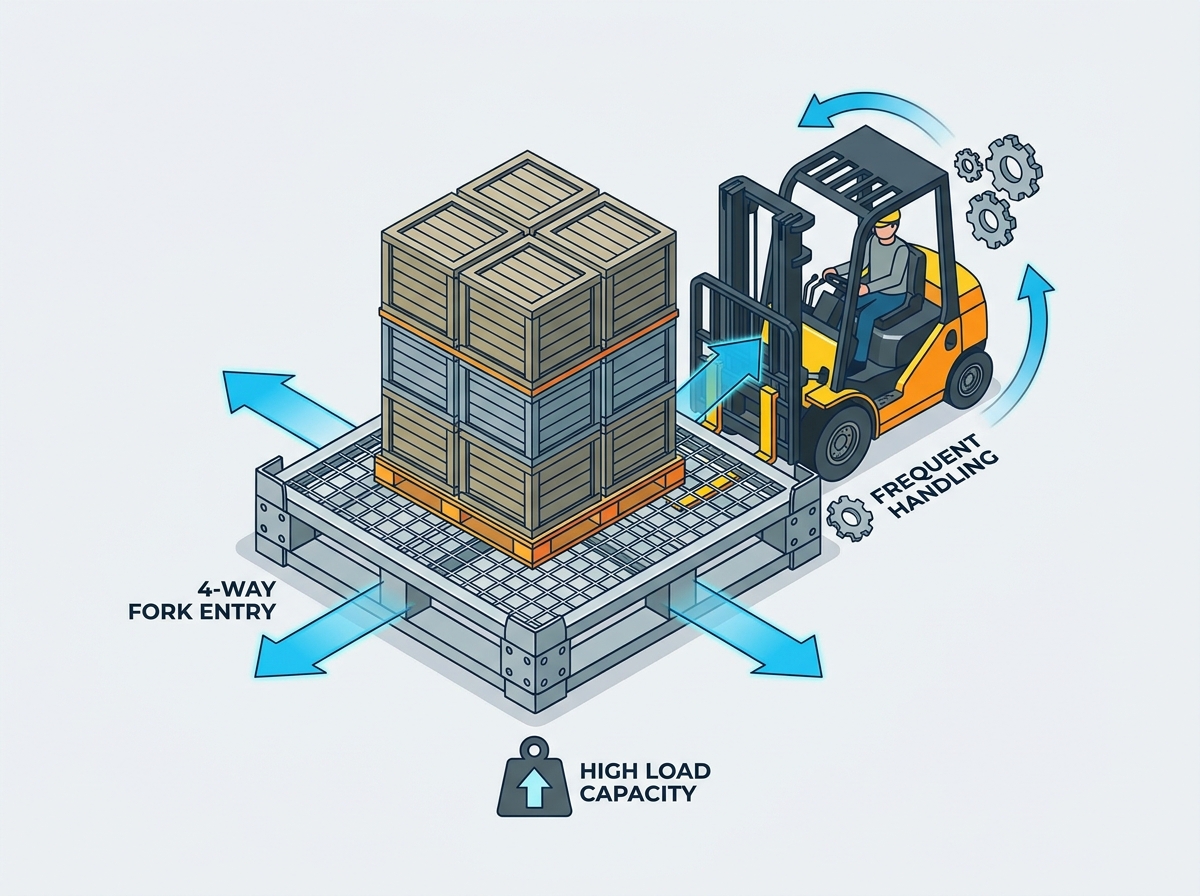
Structural Resilience: Heavy duty metal pallets eliminate the splintering and fastener failures common in wood pallets, absorbing forklift tine impacts through continuous welded joints and reinforced steel profiles.
Handling Efficiency: Utilizing a 4 way fork entry steel pallet drastically reduces handling time and operator maneuvering in tight warehouse aisles.
Load Integrity: High load steel pallets maintain zero deflection under maximum dynamic capacities, ensuring safe transit for dense, heavy industrial materials.
The Mechanics of Forklift Damage in High-Cycle Operations
Dynamic Load Stress vs. Static Load Capacity
Understanding pallet failure requires a strict differentiation between static storage limits and dynamic load stress. Static capacity refers to the maximum weight a pallet can support while resting stationary on a concrete floor. In this state, gravity pulls straight down, and the load distributes evenly across the floor. In contrast, dynamic forces multiply exponentially the moment a forklift engages the load. When a machine lifts, tilts, and transports a fully loaded platform, the kinetic energy generates severe localized stress across the pallet's structural members.
Consider a forklift carrying 4,000 pounds of industrial components. If the operator drives over a dock plate or an uneven floor joint at five miles per hour, the resulting shockwave transfers directly into the pallet frame. Continuous dynamic stress accelerates material fatigue. In plastic pallets, this constant flexing under heavy loads breaks down polymer chains, leading to sudden, catastrophic cracking during transit. Wood pallets suffer from fastener pull-through. The dynamic shifting of heavy cargo forces nails and staples to widen their entry holes, eventually causing the stringers and deck boards to separate. Steel platforms counteract this by utilizing materials with high yield strengths, ensuring the structure absorbs kinetic energy without permanent deformation. The rigidity of the steel frame ensures that the dynamic forces do not compromise the structural integrity of the platform, even under continuous, high-speed forklift operation.
Tine Impact and Structural Fatigue
Forklift tine strikes are an unavoidable reality in fast-paced logistics. Operators navigating tight aisles, managing aggressive braking, or dealing with misaligned entries will inevitably impact the pallet structure with heavy steel forks. A standard five-inch wide steel fork backed by a 9,000-pound machine acts like a chisel when it hits a pallet at speed. Standard pallets absorb these blunt force impacts poorly. A single misaligned entry can shatter a wooden stringer or puncture a plastic structural rib, instantly compromising the load-bearing integrity of the entire unit.
The success criteria for a replacement solution hinge entirely on impact absorption. A robust steel frame utilizes thick-gauge profiles designed to deflect these strikes. Instead of transferring the destructive energy into weak joints or brittle materials, the steel frame distributes the force across its continuous welded structure. This prevents localized structural fatigue and ensures the deck remains perfectly intact, even after thousands of aggressive forklift cycles. When a tine strikes a steel stringer, the metal may scratch or dent slightly, but it will not splinter or collapse. This predictable durability allows warehouse managers to maintain high operational speeds without constantly worrying about catastrophic pallet failure during a lift.
Engineering Features of a Heavy Duty Metal Pallet
Welded Joints and Deflection Resistance
The core strength of industrial steel platforms lies in their construction methodology. Premium designs rely on robotic welding to fuse tubular steel framing into a single, unified structure. Unlike wood pallets held together by friction-based fasteners, or plastic pallets molded with inherent weak points, continuous welded joints ensure that stress is evenly distributed across the entire frame. This manufacturing precision eliminates the micro-movements that typically cause platforms to loosen over time. MIG welding techniques provide deep penetration into the steel joints, creating a bond that is often stronger than the surrounding metal itself.
Rigid metal construction is specifically engineered to prevent load deflection, commonly known as sagging. Zero deflection is a critical requirement for automated storage and retrieval systems (ASRS), where optical sensors and robotic shuttles demand exact dimensional tolerances. If a loaded pallet sags even a few millimeters, it can jam automated machinery or destabilize during forklift transport. Heavy-duty steel framing maintains absolute dimensional stability regardless of the cargo weight. The tubular steel resists bending moments far better than solid wood or hollow plastic, ensuring the deck remains perfectly flat under maximum capacity.
The Operational Advantage of a 4 Way Fork Entry Steel Pallet
Workflow efficiency in high-density storage facilities depends heavily on how quickly operators can engage and move materials. Traditional two-way stringer pallets restrict forklift access to only two sides, forcing operators to execute time-consuming maneuvers to align their machines properly. This limitation causes severe bottlenecks in narrow aisles and loading docks. Operators waste valuable minutes repositioning loads just to get the correct angle for insertion.
Implementing a 4 way fork entry steel pallet drastically alters this dynamic. The engineered block design allows counterbalance forklifts, reach trucks, and motorized pallet jacks to engage the platform from any angle. This omnidirectional access reduces physical strain on operators, minimizes the risk of collision with adjacent racking, and significantly cuts down on maneuvering time. The structural blocks in these four-way designs are reinforced with internal steel gussets to ensure they withstand the same impact forces as continuous stringers. You can load trucks faster, organize staging areas more efficiently, and reduce the overall traffic congestion on your warehouse floor.
Surface Treatments: When to Specify a Galvanized Steel Pallet
Bare steel is highly susceptible to oxidation, making surface treatments a mandatory engineering consideration. The choice of treatment dictates the platform's survival in harsh industrial environments. Powder coating provides a durable, baked-on finish suitable for dry, indoor warehouses. It resists chipping and offers color-coding options for inventory management, but it can fail if the coating is deeply scratched by forklift tines, exposing the raw steel to ambient humidity. Once rust penetrates under a powder coat, it can cause the finish to flake off in large sections.
For operations involving moisture, chemical exposure, outdoor storage, or extreme temperature fluctuations, a galvanized steel pallet is the absolute requirement. Hot-dip galvanizing submerges the welded steel frame into molten zinc at temperatures exceeding 800 degrees Fahrenheit. This creates a metallurgical bond that protects the steel inside and out. This thick zinc coating acts as a sacrificial anode. Even if deeply gouged by machinery, the surrounding zinc will oxidize before the underlying steel rusts. This ensures decades of corrosion resistance in maritime, agricultural, or cold-storage applications where condensation and moisture are constant threats.
Evaluating High Load Steel Pallets for Forklift Compatibility
Fork Entry Gaps and Tine Clearances
Integrating steel platforms into an existing forklift fleet requires careful measurement of fork entry gaps. Standard compatibility dictates that a metal pallet must maintain vertical clearances of 90mm or greater. If the entry gap is too narrow, operators risk tine binding, where the forks become wedged inside the pallet structure. This leads to dangerous lifting scenarios where the pallet may violently dislodge during transport, or the operator may accidentally lift the entire racking structure when trying to extract the forks.
To mitigate operator error during insertion, premium steel designs incorporate chamfered edges or guided entry profiles along the fork openings. These angled surfaces act as physical guides, smoothly directing misaligned tines into the correct position without catching on the structural framing. This small engineering detail significantly reduces the blunt force trauma inflicted on the pallet daily. It also speeds up the loading process, as operators do not have to be perfectly precise with their approach angles. The guided entry does the micro-adjusting for them.
Weight Considerations: Steel vs. Aluminum and Forklift Limits
A realistic trade-off in upgrading to metal infrastructure is the inherent weight of the platform itself. A heavy duty steel pallet often weighs between 60 and 120 pounds empty, depending on the gauge of the steel and the deck configuration. Aluminum alternatives provide robust support and are significantly lighter, making them easier to handle manually. However, steel remains the superior choice for absolute maximum load capacities and extreme impact resistance, as aluminum is softer and more prone to bending under severe forklift strikes.
Facility managers must implement a strict framework for calculating the combined weight of the steel platform and the cargo. Forklifts operate on a specific load center calculation, typically based on a 24-inch center of gravity. Adding 100 pounds of dead weight at the base of the load can push a forklift closer to its maximum safe lifting capacity. Operators must consult their equipment's load capacity charts to ensure the combined mass does not exceed the safe operational limits of the counterbalance forklifts. Ignoring this dead weight calculation can lead to rear-wheel lift, loss of steering control, and severe tip-over accidents on the loading dock.
Slip Resistance and Load Stability
A common operational concern with metal platforms is the risk of metal-on-metal slippage. When smooth steel forklift tines engage a smooth steel pallet deck, the lack of friction can cause the platform to slide forward during sudden stops, aggressive acceleration, or sharp turns. This instability poses a severe risk to both the cargo and nearby personnel. A sudden stop could send a 2,000-pound load sliding right off the forks.
To secure the load, a high load steel pallet is engineered with specific mitigation features. Anti-slip deck profiles, such as diamond-tread patterns or corrugated stamping, increase the surface friction against the cargo. Additionally, rubberized inserts or textured surface treatments can be applied to the underside of the fork entry points. These high-friction contact zones grip the forklift tines securely, ensuring absolute load stability during dynamic transit. Some designs also incorporate raised perimeter lips to physically prevent boxed cargo from sliding off the edge of the deck during transport.
Advanced Load Distribution and Racking Integration
Point-Load Dynamics on Wire Decking
Before deploying steel platforms at scale, warehouse managers must assess how these heavy units interact with existing racking infrastructure. Standard warehouse racking systems are often designed with the uniform load distribution of wood pallets in mind. Wood flexes and spreads its weight evenly across the beams and wire decking. Steel pallets, particularly those with tubular feet or specific block designs, create concentrated point-loads. The entire weight of the cargo and the pallet transfers through four or six small contact points.
If these point-loads do not align perfectly with the structural beams of the racking system, they can cause localized damage. Standard wire decking is rarely rated to handle the concentrated point-load of a fully loaded steel platform. The wire mesh will warp, bend, and eventually fail, dropping the load through the rack. Facilities must evaluate their current pallet racking systems carefully. You may need to upgrade to heavy-duty structural beams or install specific pallet supports, such as flanged crossbars, that align exactly with the footprint of the metal units. Ensuring the racking infrastructure matches the point-load distribution of the new platforms is non-negotiable for warehouse safety.
Custom Footprints for Specialized Cargo
One of the major engineering advantages of steel platforms is the ability to fabricate custom footprints for specialized cargo. Standard 48x40 dimensions work well for general logistics, but industrial manufacturing often involves oversized, awkwardly shaped, or top-heavy components. Wood and plastic molds are restricted to standard sizes, making it difficult to safely transport large machinery parts or long steel extrusions.
Steel framing can be welded to exact dimensional specifications to match the center of gravity of specialized loads. If you are moving heavy engine blocks, oversized valves, or long pipe sections, a custom steel platform ensures the load remains perfectly balanced on the forklift tines. You can engineer specific tie-down points, cradle supports, and reinforced lifting lugs directly into the pallet frame. This level of customization eliminates the need for dangerous makeshift rigging and ensures that even the most difficult cargo can be handled safely and efficiently by a standard forklift fleet.
Implementation Risks and Operational Adjustments
Operator Safety and Handling Protocols
Transitioning a facility to metal platforms requires immediate updates to daily handling protocols. Because steel structures are heavy and unyielding, manual handling introduces new ergonomic risks. Facilities must enforce mandatory safety protocols, including the use of heavy-duty, cut-resistant gloves whenever personnel must manually adjust or position a steel platform. This prevents severe hand injuries from pinch points or sharp edges that may develop after years of heavy use.
Strict rules must be established regarding the storage of empty units. Personnel must be prohibited from storing empty metal pallets on their sides. A heavy steel platform standing on edge presents a severe tip-over hazard that can crush feet or legs. Furthermore, clear guidelines must prohibit personnel from standing or walking on the metal decks. The surface can present serious slip-and-fall risks, particularly in environments prone to moisture, condensation, or ambient oil spills. You must train your floor staff to treat steel platforms as heavy machinery components rather than disposable packaging.
Safety Protocol Adjustments for Metal Platforms
Operational Hazard
Standard Pallet Practice
Required Metal Pallet Protocol
Manual Handling
Standard leather gloves, single-person lift.
Heavy-duty impact gloves, mandatory two-person team lift for units over 50 lbs.
Empty Storage
Occasionally stacked on edge to save space.
Strictly flat stacking only. Zero tolerance for side-storage due to tip-over mass.
Pedestrian Access
Walking across empty decks occasionally tolerated.
Absolute prohibition of walking on decks to prevent severe slip-and-fall injuries.
Forklift Engagement
Rapid, aggressive entry relying on wood flexibility.
Controlled, aligned entry required to prevent metal-on-metal sliding or machine shock.
Facility Infrastructure and Racking Compatibility
Beyond the wire decking, you must inspect the structural integrity of your uprights and baseplates. When a forklift operator makes a mistake and pushes a heavy steel pallet into a racking upright, the impact force is significantly higher than a wood pallet strike. Wood absorbs energy by breaking; steel transfers the energy directly into the rack. This can cause severe buckling in standard roll-formed racking columns.
To mitigate this risk, facilities implementing steel platforms should install heavy-duty column protectors and reinforced end-of-aisle guards. These physical barriers absorb the shock of accidental forklift impacts, protecting the structural integrity of the racking system. Additionally, you should conduct a thorough audit of your aisle widths. Because steel pallets do not forgive misaligned turns, your operators need adequate space to maneuver their counterbalance forklifts without scraping the racking. Expanding aisle widths by just a few inches can drastically reduce the frequency of accidental impacts and improve overall handling speeds.
Conclusion
Frequent forklift handling of dense, heavy materials strictly requires the structural rigidity and impact resistance that only metal infrastructure can provide. While standard platforms suffice for light, static storage, they become dangerous liabilities in high-cycle industrial environments. Upgrading to steel ensures zero load deflection, eliminates splintering hazards, and maintains dimensional stability across thousands of transit cycles. Procurement teams should base their shortlisting logic on maximum dynamic load requirements, environmental exposure levels, and the specific dimensional limits of their forklift fleet.
Audit your current forklift fleet's load capacity charts to ensure they can safely handle the combined weight of steel platforms and maximum cargo.
Measure your existing racking systems to confirm compatibility with the point-load distribution of steel pallet footprints.
Assess your facility's environmental conditions to determine if standard powder coating is sufficient or if hot-dip galvanization is required.
Request technical specification sheets for heavy-duty steel options to verify exact fork entry gaps and tine clearances.
Update your warehouse safety manuals to include mandatory two-person lift protocols and strict flat-stacking rules for empty metal units.
FAQ
Q: What is the dynamic load capacity of a heavy duty steel pallet?
A: Dynamic load capacities typically range from 2,000 lbs to over 10,000 lbs. The exact limit depends entirely on the steel gauge, the density of the tubular framing, and the specific engineering of the welded joints used in the platform's construction.
Q: Can any forklift handle a 4 way fork entry steel pallet?
A: Most standard counterbalance forklifts, reach trucks, and motorized pallet jacks are fully compatible. However, you must verify that your equipment's tine length and vertical thickness align with the pallet's engineered fork entry gaps to prevent binding.
Q: Are galvanized steel pallets safe for outdoor storage?
A: Yes. The hot-dip galvanizing process creates a thick metallurgical zinc bond that actively prevents rust and corrosion. This makes them highly durable and completely safe for permanent outdoor storage, maritime environments, and extreme weather exposure.
Q: How much does a heavy duty metal pallet weigh?
A: Realistic weights range from 60 lbs for lighter-duty profiles to over 150 lbs for extreme high-capacity models. This dead weight must be factored into your forklift's safe lifting capacity and requires strict manual handling protocols.
Q: Do metal pallets slide off forklift tines easily?
A: Unmodified smooth steel can be slippery. However, modern industrial designs incorporate specific anti-slip features, such as diamond-tread deck profiles, corrugated stamping, and rubberized fork entry inserts, to ensure absolute load stability during transit.
Q: How long does a high load steel pallet last compared to wood?
A: Heavily used wood platforms typically survive one to three years before requiring disposal due to splintering and fastener failure. In contrast, engineered steel platforms reliably maintain structural integrity for ten to fifteen years or more under the same harsh conditions.
WhatsApp: +8618919627550 Tel: +86-18919627550 Email: anhuiwenrui@gmail.com 18919627550@163.com Address: Factory Building A2, southwest corner of the intersection of Zong'er Road and Hengyi Road,Hefei Circular Economy Demonstration Park, Feidong County,Hefei City, Anhui Province