Factory Building A2, southwest corner of the intersection of Zong'er Road and Hengyi Road,Hefei Circular Economy Demonstration Park, Feidong County,Hefei City, Anhui Province
You are here: Home » News » Are Export Steel Pallets Suitable for Ocean Container Shipping?
Are Export Steel Pallets Suitable for Ocean Container Shipping?
Views: 0 Author: Site Editor Publish Time: 2026-08-09 Origin: Site
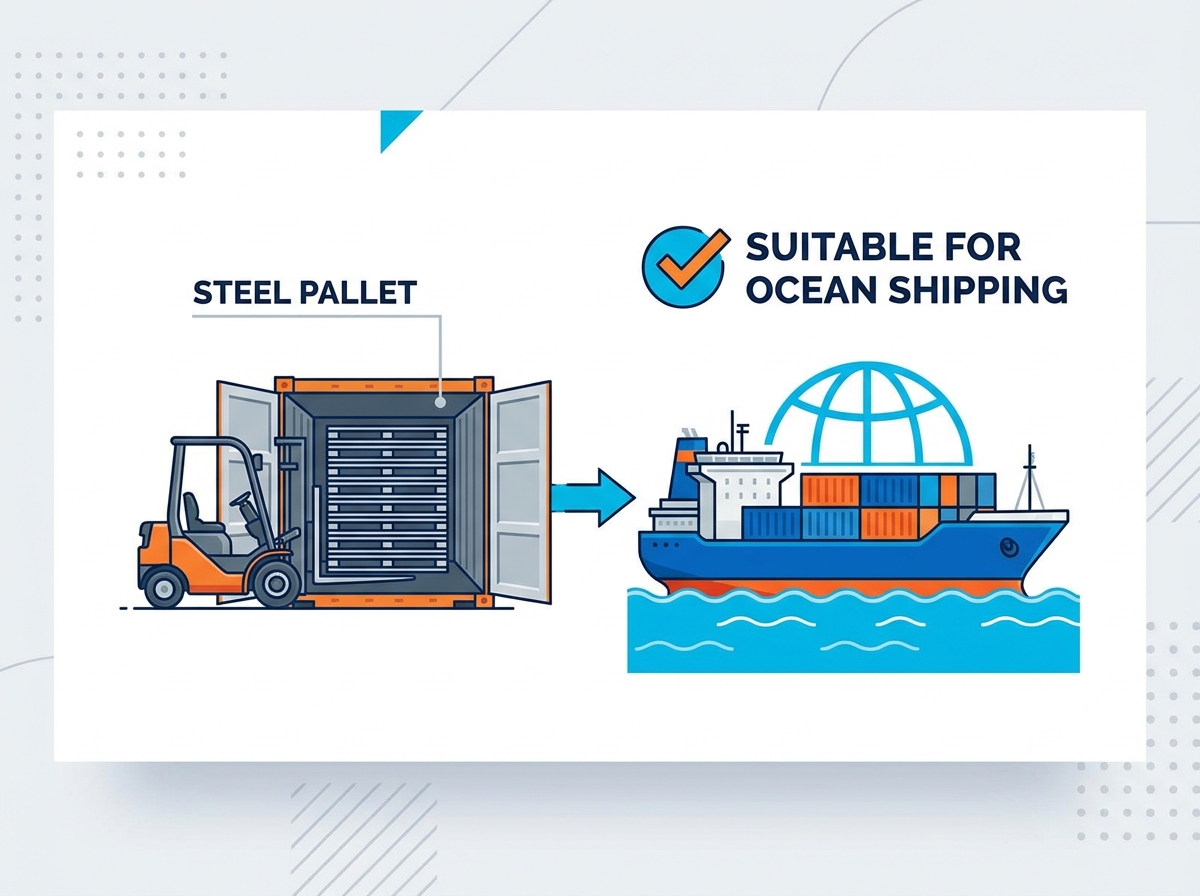
Ocean container shipping subjects cargo to extreme dynamic stresses, prolonged moisture exposure, and strict international customs regulations that frequently compromise standard packaging. Reliance on traditional wooden pallets for heavy or high-value exports often results in structural failure during transit, cargo damage from container condensation, or costly quarantine delays due to ISPM 15 non-compliance. Companies transitioning from expensive air freight to ocean freight often underestimate the upgraded mechanical support required for sea transit. Determining whether an Export Steel Pallet justifies its higher tare weight and upfront cost requires a rigorous evaluation of load unitization requirements, maritime environmental factors, and operational viability across the supply chain.
ISPM 15 Exemption: Steel construction inherently bypasses international phytosanitary regulations, eliminating fumigation costs, documentation errors, and customs delays at destination ports.
Unmatched Load Capacity: Engineered for high dynamic and static loads, steel prevents bottom-tier collapse and structural deflection during turbulent ocean transits.
Environmental Resilience: Treated metal surfaces resist the salt-air corrosion and extreme moisture fluctuations that degrade wood and weaken cardboard or pressboard alternatives.
The Weight Trade-off: While heavier than alternatives, the durability of steel offers a superior return on investment for heavy industrial goods, sensitive dry foods, and closed-loop international supply chains.
The Harsh Realities of Ocean Freight: Why Pallet Selection Matters
Dynamic Stresses and Load Shifting
Multi-week ocean voyages expose cargo to continuous multi-directional forces. Vessels experience pitch, roll, heave, sway, surge, and yaw as they navigate ocean swells. These six degrees of motion transfer immense kinetic energy directly into the shipping container and the cargo secured within it. When stacking heavy industrial goods, the bottom tier bears the cumulative weight of the entire load multiplied by the gravitational forces generated by the ship's movement.
To understand the physical toll on packaging, consider the specific forces at play during a standard trans-Pacific routing:
Pitch: The up-and-down movement of the vessel's bow and stern, which shifts cargo weight longitudinally against the container doors and front wall.
Roll: The side-to-side tilting that can reach angles of up to 30 degrees in heavy weather, exerting massive lateral shear forces on the base of the packaging.
Heave: The vertical lift and drop of the entire ship, which momentarily increases the effective weight of the cargo during the upward thrust, crushing inadequate bottom-tier supports.
Sway and Surge: Lateral and longitudinal movements that cause internal friction between stacked units if load unitization is compromised.
Inadequate bases buckle under these dynamic stresses. Wooden stringers crack, and plastic decks suffer from creep, causing the entire stack to lean or collapse. A pallet collapse inside a shipping container creates a domino effect, damaging adjacent cargo and making safe unloading nearly impossible. Forklift operators at destination ports often refuse to handle structurally compromised loads, requiring manual repacking that adds days to transit times and incurs massive labor charges.
Moisture, Salinity, and Temperature Fluctuations
Shipping containers act as massive steel heat sinks. As vessels cross different climate zones, the temperature inside a container fluctuates wildly. Warm air holds more moisture than cold air. When a container moves from a hot, humid environment into a colder region, the trapped air cools rapidly, reaching its dew point. Condensation forms on the container ceiling and drips down onto the cargo.
The physics of this condensation cycle are aggressive. A container loaded in a tropical port at 30°C and 80% relative humidity holds a significant volume of water vapor. When that vessel reaches a North Atlantic port at 10°C, the air can no longer hold that moisture. The resulting condensation rains down on the cargo daily. Prolonged exposure to this trapped moisture and salt-laden ocean air compromises wood integrity rapidly. Wood acts as a sponge, absorbing condensation which reduces its load-bearing capacity by up to 50% and promotes aggressive mold growth.
For moisture-sensitive cargo like dry food products, pharmaceuticals, or sensitive electronics, mold spores and dampness migrating from a wet wooden base ruin the entire shipment. Even export-grade corrugated cardboard or pressboard alternatives disintegrate quickly when exposed to sustained high humidity, leaving the cargo completely unprotected against the steel floor of the container.
Regulatory Hurdles and Carrier-Enforced Limits
International maritime trade operates under strict phytosanitary regulations designed to prevent the global spread of wood-boring insects and plant diseases. The International Standards for Phytosanitary Measures No. 15 (ISPM 15) requires all raw wood packaging to undergo certified heat treatment or methyl bromide fumigation. Securing this certification involves direct financial costs, administrative overhead, and strict documentation requirements.
Failure to present flawless ISPM 15 documentation results in immediate quarantine at the destination port. Customs authorities routinely reject non-compliant cargo, forcing shippers to pay for immediate repacking, mandatory chemical treatments, or complete destruction of the packaging materials. Demurrage and detention charges during these customs holds frequently exceed hundreds of dollars per day.
Additionally, ocean carriers enforce strict dimensional and weight limits. Out-of-gauge packaging that warps or swells beyond standard dimensions leads to rejected loads at the terminal gate. Wood naturally expands when it absorbs moisture, meaning a pallet that met dimensional tolerances at the origin facility might exceed them by the time it reaches the port, causing it to miss scheduled vessel departures entirely.
Evaluating the Export Steel Pallet for Sea Freight
Structural Integrity and High Load Capacity
When transporting heavy machinery, automotive parts, or bulk liquids, the physical limits of the packaging base dictate the safety of the entire shipment. A heavy duty steel pallet offers static and dynamic load limits that far exceed those of premium hardwood and export-grade plastic. Steel frames resist the bending and bowing that plague softer materials under sustained, high-density loads.
Deflection rates—the degree to which a surface bends under weight—are critical for container stability. High deflection causes strapping to loosen and center-of-gravity shifts. Steel maintains near-zero deflection even when loaded with several tons of dense industrial equipment. This rigid structural integrity ensures that stacked cargo remains perfectly vertical throughout the voyage, preventing the lateral shifts that cause container imbalances and handling accidents at the port.
The structural design of these metal bases typically incorporates tubular steel or roll-formed profiles welded at high-stress junctions. This engineering distributes the payload weight evenly across the footprint, preventing point-loading damage to the container floor. When shipping dense items like engine blocks, steel coils, or IBC totes filled with industrial fluids, this load distribution is mandatory to prevent the cargo from punching through the timber decking of the shipping container.
Load Unitization and Cargo Securing Methods
Effective load unitization transforms individual cartons or loose components into a single, immovable block. This process relies heavily on high-tension steel strapping, heavy-duty polyester (PET) banding, and multi-layer stretch wrapping. The rigid, unyielding frame of a metal base provides superior mechanical support for these securing methods.
To properly secure heavy freight to a metal base for ocean transit, logistics teams follow specific lashing procedures:
Position the cargo so the center of gravity rests directly over the central support beams of the metal frame.
Apply rigid edge protectors to the cargo to prevent high-tension strapping from biting into the product packaging.
Route steel or PET strapping through the designated lashing rings or under the reinforced deck boards of the metal frame.
Apply maximum tension to the straps using pneumatic or battery-operated tensioning tools.
Wrap the entire unitized load in heavy-gauge stretch film to bind the upper tiers and provide a secondary moisture barrier.
When operators apply maximum tension to securing straps, a steel frame holds firm without crushing or splintering. Proper load unitization on a steel base absorbs handling stresses far better than yielding wooden or cardboard alternatives. The rigid deck prevents cargo from sinking into the base, maintaining tight strap tension across thousands of miles of ocean transit. This unyielding foundation ensures that the unitized load acts as a single cohesive mass, drastically reducing the risk of internal friction and product abrasion.
Material Resilience and Corrosion Resistance
Maritime environments are notoriously corrosive. Bare metal oxidizes rapidly when exposed to salt air and high humidity. Utilizing a galvanized steel pallet directly addresses this vulnerability. The hot-dip galvanization process coats the steel in a protective layer of zinc, creating a metallurgical bond that seals the underlying metal from the atmosphere.
This zinc coating acts as a sacrificial anode. Even if the surface is scratched by a forklift tine during loading, the surrounding zinc will oxidize before the exposed steel, preventing rust from compromising the structural integrity of the frame. This treatment prevents oxidation and rust even during extended maritime exposure and extreme temperature shifts.
Beyond corrosion resistance, treated steel offers exceptional ease of sanitization. Unlike wood, which features porous surfaces that trap bacteria, chemical spills, and pest larvae, smooth metal surfaces can be pressure-washed, chemically sterilized, or thermally sanitized without degrading the material. This makes steel highly suitable for hygiene-critical imports, including pharmaceuticals, medical devices, and food-grade products. The expected lifespan of treated steel in harsh environments spans many years, far outlasting any organic alternative.
Handling Efficiency at Ports and Warehouses
Congested port terminals and busy cross-docking facilities require rapid, error-free material handling. A 4 way fork entry steel pallet accelerates loading and unloading operations by allowing forklift operators to approach and lift the load from any side. This multi-directional access is particularly valuable inside the tight confines of a shipping container, where maneuvering space is strictly limited.
Inside a standard 20ft or 40ft container, forklift operators have zero margin for error. The ability to pinwheel a load—turning it 90 degrees to maximize floor space utilization—relies entirely on four-way entry access. Wooden pallets often feature two-way entry or partial four-way entry with notched stringers that easily snap under the weight of a heavy load when lifted from the side. Steel frames provide full-strength lifting points from all four directions.
Dimensional compatibility with standard ISO shipping containers is non-negotiable for ocean freight. Steel bases are precision-manufactured to exact tolerances, ensuring consistent external dimensions that maximize internal cube utilization. Shippers calculate precise container load plans without worrying about the dimensional variations, warping, or swelling commonly associated with wooden pallets, ensuring strict adherence to carrier size limits and maximizing freight efficiency.
Comparative Analysis: Metal Pallets vs. Wood and Plastic
Ocean Freight Packaging Material Comparison
Material Type
Dynamic Load Capacity
Moisture Resistance
ISPM 15 Compliance
Deflection Rate
Steel
Extremely High (>2000 kg)
Excellent (Galvanized)
Exempt
Near Zero
Treated Wood
Moderate (1000 - 1500 kg)
Poor (Absorbs Water)
Requires Certification
Moderate to High
Export Plastic
Moderate to High
Excellent
Exempt
High (Creep under load)
Deflection and Load Behavior Under Maritime Conditions
Material Type
Behavior in Freezing Temperatures
Behavior in High Heat (40°C+)
Impact Resistance (Forklift Strikes)
Steel
Maintains full structural integrity
Maintains full structural integrity
Dents but retains load-bearing capacity
Treated Wood
Moisture freezes, causing internal cracking
Dries out, shrinks, and loosens fasteners
Splinters, leading to immediate structural failure
Export Plastic
Becomes highly brittle and shatters easily
Softens, leading to severe deck creep
Cracks or punctures upon heavy impact
Metal vs. Treated Wood
The decision between a metal pallet and treated wood centers on balancing upfront procurement costs against long-term operational efficiency. Wood requires a lower initial investment but carries hidden recurring costs. Wood splinters, loses nails, and requires frequent repair or complete replacement after just a few ocean voyages. Disposal costs at destination ports also add up, as broken wooden pallets incur waste management fees.
Steel demands a higher initial capital outlay but offers a lifespan measured in decades rather than months. Steel is easily repairable through standard welding processes and retains high scrap value at the end of its lifecycle. More importantly, steel completely eliminates ISPM 15 compliance paperwork, heat treatment scheduling, and the associated quarantine risks that threaten delivery timelines and supply chain reliability. When a wooden pallet fails during transit, the resulting cargo damage often exceeds the cost of upgrading the entire fleet to metal.
Metal vs. Export Plastic Pallets
Export-grade plastic offers moisture resistance and ISPM 15 exemption, making it a common alternative to wood. However, plastic performance degrades significantly under extreme temperature variations. In freezing conditions, plastic becomes brittle and shatters upon impact from forklift tines. In high-heat environments, plastic softens, leading to structural creep where the deck permanently deforms under sustained heavy loads.
Steel maintains complete thermal stability across all climate zones. A high load steel pallet demonstrates absolute load-bearing superiority when exporting exceptionally dense or unevenly distributed freight. While plastic bows under the asymmetric weight of heavy industrial engine blocks or bulk fluid IBCs, steel provides an unyielding foundation that guarantees container stability from origin to destination. Plastic also lacks the friction required to keep heavy loads from sliding during severe vessel rolls, whereas steel decks can be engineered with anti-slip profiles to lock cargo in place.
Trade-offs and Implementation Risks in Ocean Shipping
The Tare Weight Factor and Freight Costs
Metal construction inherently increases tare weight. A standard steel base weighs significantly more than its wooden or plastic counterpart. Shippers must calculate the impact of this added tare weight on overall container payload limits and strict gross weight restrictions mandated by Verified Gross Mass (VGM) compliance regulations under the SOLAS convention. Exceeding VGM limits results in severe fines and cargo being rolled to later vessels.
One distinct advantage of steel in VGM calculations is weight consistency. A specific steel model weighs exactly the same every time. Wood weight varies wildly depending on ambient humidity and moisture content; a dry wooden pallet might weigh 20 kg, while the exact same pallet left in the rain weighs 30 kg. This variance causes VGM discrepancies at the port weighbridge. Steel eliminates this variable, allowing logistics teams to declare precise, accurate weights on their shipping manifests.
Despite the weight penalty, steel remains highly economically viable for ocean freight. Ocean shipping is typically volume-constrained rather than weight-constrained; containers usually run out of physical space before they hit their maximum weight capacity. This dynamic makes the heavier tare weight of steel negligible in sea transit. Conversely, air freight is strictly weight-constrained and highly cost-prohibitive for heavy packaging, explaining why steel is rarely utilized in aviation logistics.
Supply Chain Models: Open-Loop vs. Closed-Loop
The financial viability of steel packaging depends heavily on the underlying supply chain model. In an open-loop system, where goods are shipped one-way to disparate customers with no mechanism for asset return, using premium steel represents a significant sunk cost. For single-trip exports, shippers must weigh the high upfront cost against the specific risk of cargo damage or customs rejection.
Steel excels in closed-loop supply chains. When a company ships components between its own international manufacturing facilities or operates a dedicated returnable asset tracking program, steel becomes an appreciating asset. Implementing reverse logistics, pallet pooling, and structured recovery in international trade routes allows companies to amortize the initial procurement cost over hundreds of voyages, drastically reducing the per-trip packaging expense. Automotive manufacturers and heavy equipment suppliers frequently utilize closed-loop steel packaging to move engines and transmissions between global assembly plants.
Upfront Capital Expenditure and ROI
Procurement teams face the challenge of justifying higher initial capital expenditures. Analyzing this cost requires projecting the number of expected trips and calculating the exact financial impact of reduced product damage. When cargo arrives intact without moisture damage, mold, or structural crushing, the savings in insurance claims, replacement manufacturing, and expedited replacement shipping quickly offset the cost of premium packaging.
The ROI timeline accelerates specifically for high-value, hazardous, or heavy-industrial cargo shipments where failure is not an option. If a single compromised wooden base results in the destruction of a $500,000 industrial machine or causes a hazardous material spill inside a container, the cost of a steel base becomes functionally irrelevant. For these high-stakes shipments, steel acts as a necessary insurance policy against catastrophic transit failure, eliminating the variables of wood degradation and plastic deformation.
Conclusion
Audit current transit damage rates to identify specific failure points in your existing wooden or plastic packaging.
Calculate your standard container payload weight thresholds to ensure the heavier tare weight of steel complies with VGM regulations.
Determine the logistical feasibility of implementing reverse logistics for your specific international trade routes to maximize asset reuse.
Request a technical specification sheet and a physical prototype for real-world load testing before committing to a full fleet replacement.
FAQ
Q: Do export steel pallets require ISPM 15 certification for international shipping?
A: No. Steel is entirely exempt from ISPM 15 regulations. Because metal cannot harbor wood-boring insects or plant diseases, it does not require heat treatment, methyl bromide fumigation, or phytosanitary stamping, eliminating customs delays related to packaging compliance.
Q: How much does a heavy duty steel pallet weigh compared to a standard wooden pallet?
A: A heavy-duty steel model typically weighs between 25 kg and 40 kg, depending on the load rating and dimensions. Standard wooden pallets generally weigh between 15 kg and 25 kg. Shippers must account for this increased tare weight when calculating container VGM.
Q: Will a galvanized steel pallet rust inside an ocean shipping container?
A: A properly galvanized surface resists rust exceptionally well. The zinc coating acts as a sacrificial barrier against the salt-laden air and high humidity found in maritime environments, preventing the underlying steel from oxidizing during extended ocean voyages.
Q: Are metal pallets dimensionally compatible with standard 20ft and 40ft shipping containers?
A: Yes. They are precision-manufactured to standard international dimensions. This strict dimensional consistency ensures optimal floor space utilization inside standard ISO 20ft, 40ft, and High Cube shipping containers without the warping associated with wood.
Q: What is the average dynamic load capacity of a high load steel pallet?
A: High-load steel models are engineered to support dynamic loads ranging from 1,500 kg to over 2,500 kg. Their static load capacities are even higher, often exceeding 6,000 kg, making them ideal for dense industrial equipment and heavy machinery.
Q: How does a 4 way fork entry steel pallet improve port handling times?
A: Four-way entry allows forklift operators to approach, lift, and maneuver the load from any of its four sides. This flexibility is critical inside the narrow confines of a shipping container, speeding up loading and cross-docking operations at congested port terminals.
WhatsApp: +8618919627550 Tel: +86-18919627550 Email: anhuiwenrui@gmail.com 18919627550@163.com Address: Factory Building A2, southwest corner of the intersection of Zong'er Road and Hengyi Road,Hefei Circular Economy Demonstration Park, Feidong County,Hefei City, Anhui Province