Factory Building A2, southwest corner of the intersection of Zong'er Road and Hengyi Road,Hefei Circular Economy Demonstration Park, Feidong County,Hefei City, Anhui Province
You are here: Home » News » Are Galvanized Planter Boxes Suitable for Commercial and Public Spaces?
Are Galvanized Planter Boxes Suitable for Commercial and Public Spaces?
Views: 0 Author: Site Editor Publish Time: 2026-08-26 Origin: Site
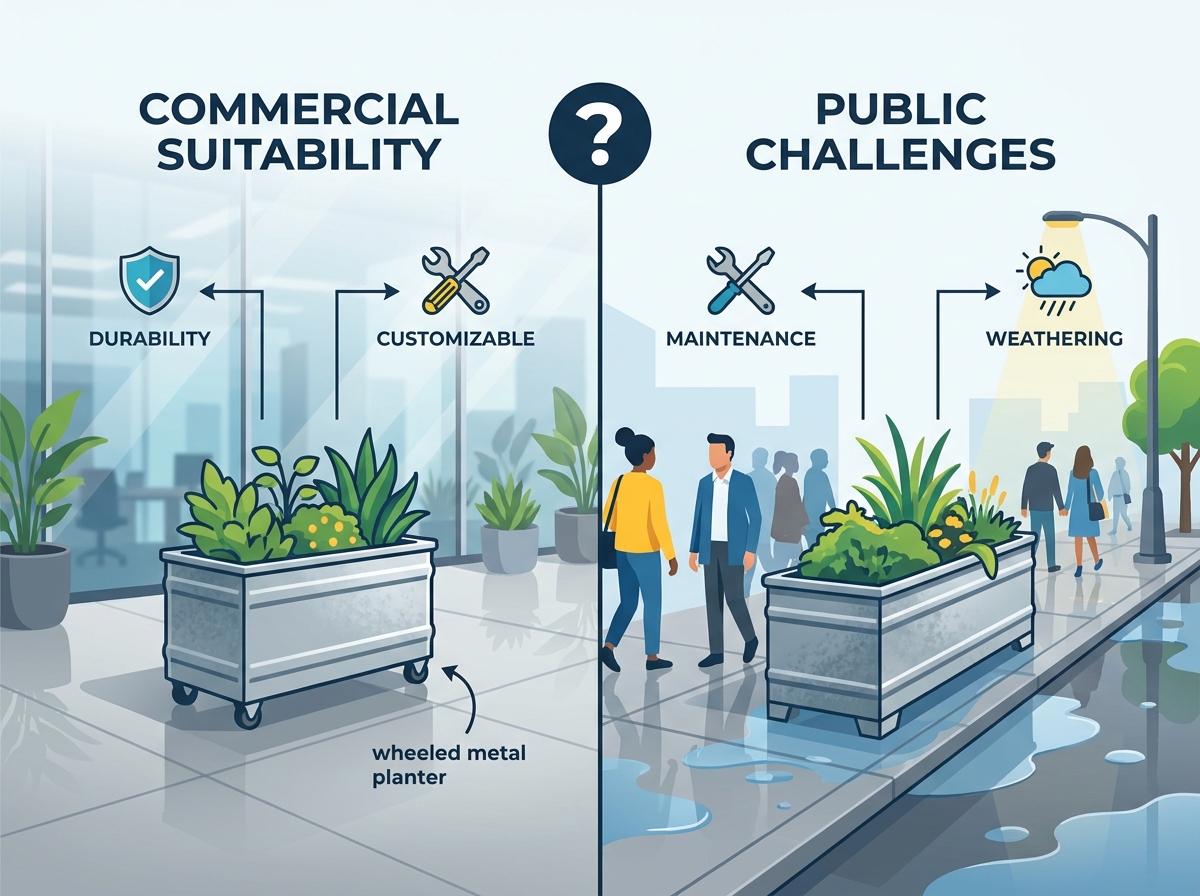
Urban planners, landscape architects, and facility managers face a persistent challenge: sourcing high-capacity planting infrastructure that withstands high foot traffic, severe weather, and potential vandalism without requiring constant replacement. Balancing aesthetic integration with structural longevity and public safety is difficult. Traditional materials like wood degrade rapidly in commercial settings due to moisture and organic decay. Concrete offers permanence but remains inflexible, heavy, and highly labor-intensive to install or relocate. We must assess whether a Galvanized Planter Box meets the rigorous success criteria of commercial landscaping. This requires an evidence-based look at structural durability, soil safety for both ornamental and edible plants, and long-term financial viability. You need solutions that perform under the stress of urban environments.
Structural Longevity & Weather Resilience: Hot-dipped galvanized steel offers a 20- to 50-year lifespan in outdoor commercial environments, significantly outperforming untreated metals and commercial-grade timber, while resisting freeze-thaw cycles that typically crack concrete.
Verified Soil Safety: Despite common misconceptions, zinc leaching from galvanized coatings is minimal, poses no toxicity threat to edible plants in urban agriculture, and remains well within environmental safety thresholds.
Design Modularity: From a standard rectangular metal planter box to a custom metal planter box, galvanized steel allows for scalable, site-specific configurations.
Operational Flexibility: Integration of heavy-duty casters creates a wheeled metal planter solution, enabling dynamic space partitioning for hospitality venues, public plazas, and seasonal events.
Framing the Problem: Success Criteria for Commercial Planters
Commercial and public spaces subject landscape infrastructure to extreme stress. Selecting the right container requires evaluating materials against a strict set of performance criteria. Infrastructure must survive both environmental extremes and human interaction. Before specifying any container for a commercial site, project managers must evaluate the site conditions through a specific sequence of steps.
Measure the pedestrian clearance required by local accessibility codes to ensure the containers do not obstruct walkways.
Calculate the maximum weight load of the underlying concrete slab or suspended deck to prevent structural overloading.
Identify the primary sun exposure angles to anticipate thermal transfer and root zone heating.
Assess the local wind loads to determine if the containers require mechanical anchoring to the pavement.
High-Traffic Durability
Containers in public squares, streetscapes, and retail centers endure constant physical impact. Maintenance carts, pedestrian collisions, and recreational activities frequently damage fragile materials. Fiberglass shatters upon heavy impact. Wood splinters and gouges easily. Steel possesses the tensile strength and elasticity to absorb blunt force without catastrophic failure. A heavy-gauge steel container resists deep scratching and structural deformation. It maintains its shape even when struck by landscaping equipment or delivery hand trucks.
Extreme Weather Resilience
Outdoor infrastructure must survive the local climate year-round. Harsh weather conditions include heavy snow loads, intense ultraviolet exposure, and drastic temperature fluctuations. Freeze-thaw cycles present the greatest threat to porous materials. When water infiltrates concrete or terracotta and subsequently freezes, it expands by approximately nine percent by volume. Concrete has a low tensile strength, typically around 400 psi, which causes it to crack under this internal pressure. Steel is entirely non-porous. It does not absorb moisture. With a tensile strength exceeding 58,000 psi, it accommodates the thermal expansion of frozen wet soil elastically without warping, cracking, or splitting.
Weight and Structural Integrity
Large commercial containers hold massive volumes of soil. Dry potting mix weighs roughly 40 pounds per cubic foot. Fully saturated planting soil often exceeds 100 pounds per cubic foot. A standard three-foot cube container holds 27 cubic feet of material. When saturated, that internal weight reaches 2,700 pounds. The outward hydrostatic pressure against the walls is immense. Weak materials bow outward over time. High-gauge steel provides the necessary rigidity to contain these loads indefinitely. Fabricators often weld internal cross-bracing into larger units to prevent any lateral deflection.
Maintenance Overhead
Facility managers must account for ongoing maintenance labor. Traditional materials demand continuous upkeep. Wood requires annual sanding and sealing to prevent rot. Hiring maintenance crews to apply sealant costs upwards of $45 per hour in labor alone. Concrete requires periodic sealing to prevent moisture ingress and staining. Galvanized steel relies on the passive protection of a zinc patina. This metallurgical barrier eliminates the need for routine surface treatments. You install it and leave it alone.
The Metallurgy of Galvanization: How It Protects the Metal Planter Box
Understanding why a metal planter box survives decades outdoors requires examining the science of galvanization. This is not a simple surface paint. It is a complex metallurgical process that fundamentally alters the exterior properties of the steel.
The Hot-Dip Process
Hot-dip galvanizing involves a rigorous preparation phase followed by immersion in molten metal. Fabricators first clean the steel using caustic solutions to remove dirt and oil. They then pickle the steel in dilute sulfuric acid to remove mill scale and rust. Finally, they dip the steel into a flux solution to prevent oxidation before the final bath. The clean steel is immersed into a kettle of molten zinc at temperatures around 840 degrees Fahrenheit. The iron in the steel reacts with the molten zinc to form a series of tightly bonded intermetallic alloy layers.
Galvanized Coating Alloy Layers
Layer Name
Composition
Hardness (DPN)
Eta Layer
100% Zinc
70 DPN
Zeta Layer
94% Zinc, 6% Iron
179 DPN
Delta Layer
90% Zinc, 10% Iron
244 DPN
Gamma Layer
75% Zinc, 25% Iron
250 DPN
Base Steel
100% Iron
159 DPN
Notice that the inner alloy layers (Zeta, Delta, Gamma) are physically harder than the base steel itself. This provides exceptional abrasion resistance against urban wear and tear.
Cathodic Protection
The most significant advantage of galvanization is cathodic protection. The zinc coating acts as a sacrificial anode. In the galvanic series, zinc is highly active, sitting at roughly -1.2 volts, while steel sits at -0.4 volts. If the surface is scratched by pedestrians or maintenance equipment, exposing the underlying steel, electrons flow from the zinc to the steel. The surrounding zinc preferentially corrodes to protect the exposed iron. The zinc sacrifices itself, oxidizing to form a protective barrier over the scratch. This prevents rust from taking hold and creeping beneath the coating.
Weathering and Patina
Freshly galvanized steel exhibits a bright, shiny, spangled finish. Exposure to the atmosphere causes the surface to weather. The zinc reacts with oxygen to form zinc oxide, then with water to form zinc hydroxide. Finally, it reacts with carbon dioxide in the air to form zinc carbonate. This transition creates a dull, matte gray patina. This oxidation layer is tightly adherent and insoluble in water. It seals the metal against moisture, urban pollutants, and salt spray.
Evaluating Safety: Zinc Leaching, Urban Agriculture, and Public Health
As urban agriculture and community gardens expand into public spaces, the safety of planting materials becomes a primary concern. Misconceptions regarding metal toxicity often deter planners from utilizing highly durable steel solutions.
Debunking the Toxicity Myth in Edible Gardens
Empirical data on zinc migration in soil substrates confirms that galvanized beds are entirely safe for growing vegetables. Zinc is an essential plant micronutrient, not a toxic heavy metal like lead or cadmium. Plants require zinc for enzyme function and growth. While a microscopic amount of zinc may leach from the walls into the immediately adjacent soil over years, it remains well within environmental safety thresholds. Human biology also requires zinc. The trace amounts potentially absorbed by root vegetables pose zero toxicity threat to public health in urban agriculture initiatives.
Soil pH and Coating Degradation
The rate of zinc breakdown depends heavily on soil chemistry. Highly acidic soils, specifically those with a pH below 5.5, accelerate the degradation of the zinc coating. To maximize lifespan and prevent unwanted chemical leaching, landscape architects should specify neutral commercial potting mixes. Maintaining a soil pH between 6.0 and 7.0 preserves the galvanized coating indefinitely. You can utilize specific soil amendments to maintain this balance.
Composted pine bark fines (provides organic matter without excessive acidity)
Coconut coir (neutral pH alternative to highly acidic peat moss)
Pumice or perlite (improves aeration without altering chemistry)
Worm castings (provides slow-release nutrients at a neutral pH)
Public Contact and Thermal Conductivity
Metal conducts heat efficiently. In direct, intense sunlight, the exterior surface of a steel container becomes hot. Planners must address the reality of metal surface temperatures to mitigate burn hazards in public spaces. Strategic placement in partially shaded areas reduces solar gain. For fully exposed plazas, utilizing double-walled designs or installing internal insulation prevents the exterior face from reaching dangerous temperatures while simultaneously protecting plant roots from thermal shock.
Design Flexibility and Spatial Delineation
Commercial landscapes require adaptable infrastructure. Steel fabrication allows for precise geometric control, enabling planners to define spaces, direct foot traffic, and integrate planting seamlessly into the architectural environment.
The Rectangular Metal Planter Box
Linear configurations serve critical functions in urban design. Utilizing a rectangular metal planter box allows facilities to establish clear boundaries without erecting permanent fencing. Restaurants use them to define outdoor dining perimeters. A 72-inch long unit acts as a physical barrier, keeping patrons safe from street traffic. Municipalities deploy them for crowd control and pedestrian guidance along busy sidewalks. The heavy weight of a fully planted rectangular unit provides a layer of passive perimeter security, protecting storefronts and pedestrian zones from vehicular intrusion.
The Custom Metal Planter Box
Standard shapes do not always fit complex architectural blueprints. Engineering a custom metal planter box solves site-specific challenges. Fabricators can create L-curves to wrap around structural columns. They can build tiered systems to navigate uneven urban topography. They can also integrate wooden seating directly into the steel frame. This modularity ensures that the planting infrastructure complements the exact spatial geometry of the plaza, rather than forcing the design to accommodate standard container sizes.
Mobility and Modular Configurations
Multi-use spaces require dynamic layouts. Plazas that host farmers' markets, seasonal festivals, or outdoor concerts need infrastructure that can be relocated quickly.
Evaluating the structural requirements for a rolling metal planter box involves calculating the total dynamic load. The base must feature reinforced steel channels to prevent the floor from sagging under the weight of wet soil when suspended on casters.
A safe, commercial-grade wheeled metal planter requires heavy-duty polyurethane casters. Planners must specify caster load ratings that exceed the maximum saturated weight by at least thirty percent. You must specify total-lock brakes that stop both the wheel rotation and the swivel pan to prevent unintended movement on sloped concrete surfaces.
Cost-to-Lifespan Ratio: Overall Value Influencing Factors
Selecting landscape infrastructure requires evaluating both the upfront capital required and the long-term financial impact. While some materials appear inexpensive initially, their rapid degradation creates a continuous cycle of maintenance and replacement.
Initial Capital Expenditure vs. Long-Term Financial Impact
Comparing the upfront cost of galvanized steel against alternatives reveals its true value. Corten steel offers a similar lifespan but often commands a premium price and stains adjacent concrete with rust runoff. Aluminum is lightweight and rust-proof but lacks the impact resistance of steel and costs significantly more. Fiberglass and commercial plastics are cheaper upfront but become brittle under UV exposure. Commercial precast concrete is highly durable but carries immense transportation and installation costs.
Planter Material Comparison for Public Spaces
Material
Impact Resistance
Freeze-Thaw Durability
Installation Weight
Estimated Lifespan
Galvanized Steel
High
Excellent
Moderate
20 - 50 Years
Precast Concrete
High
Poor (Prone to cracking)
Very Heavy
20+ Years
Commercial Wood
Moderate
Moderate
Moderate
3 - 7 Years
Fiberglass
Low (Shatters)
Good
Light
5 - 10 Years
Installation and Assembly Logistics
On-site installation logistics heavily influence project budgets. Precast concrete requires heavy machinery, cranes, and specialized rigging crews to maneuver into place. This drives up labor costs and disrupts public spaces. Steel containers are significantly lighter when empty. Many designs ship flat-packed, allowing standard landscaping crews to assemble and position them using basic hand tools and pallet jacks. This drastically reduces on-site installation overhead and logistical friction.
Replacement Cycles
The financial impact of replacing degraded infrastructure compounds rapidly. Wooden containers rot or warp within three to five years in commercial settings. Plastic alternatives crack or fade within a similar timeframe. Each replacement cycle requires purchasing new containers, paying labor to extract the old soil and plants, disposing of the degraded materials, and replanting. A single galvanized installation easily surpasses 20 years of service, completely eliminating multiple costly replacement cycles.
End-of-Life Recyclability
Municipalities and corporations increasingly prioritize sustainability. Galvanized steel is 100% recyclable at the end of its lifespan. Unlike fiberglass or treated timber, which end up in landfills, steel retains inherent scrap value. This recyclability supports corporate ESG (Environmental, Social, and Governance) reporting and aligns with circular economy principles.
Implementation Risks and Mitigation Strategies
Even the most durable materials fail if improperly installed. Successful deployment requires proactive engineering to address drainage, soil health, and thermal dynamics.
Risk: Inadequate Drainage
Galvanized steel is entirely impermeable. Without proper drainage, water accumulates at the bottom of the container. This creates anaerobic soil conditions, leading to root rot and rapid plant death. Standing water accelerates internal corrosion, degrading the zinc coating prematurely.
Mitigation: Specify commercial containers with elevated drainage ports. Install a two-inch layer of 3/4-inch washed drainage gravel at the base. Cover this aggregate with a 4-ounce non-woven geotextile filtration fabric before adding soil. This prevents fine silt from clogging the drainage holes while allowing excess water to escape freely.
Risk: Soil Nutrient Depletion
In closed-bottom commercial containers, natural soil regeneration does not occur. Earthworms and deep-soil microbes cannot access the environment. Heavy watering schedules rapidly leach essential nutrients out through the drainage ports, leaving the soil barren.
Mitigation: Implement a scheduled top-dressing program. Apply high-quality organic compost bi-annually. Utilize slow-release commercial fertilizers to maintain soil vitality. Incorporating perlite or vermiculite into the initial soil mix improves nutrient retention and aeration.
Risk: Root Zone Overheating
Thermal transfer presents a significant risk in unshaded environments. The metal absorbs solar radiation, transferring heat directly into the soil mass. This bakes root systems in exposed concrete plazas, stressing or killing the plants.
Mitigation: Install rigid foam insulation board along the interior walls prior to adding soil. Cut one-inch Extruded Polystyrene (XPS) or Expanded Polystyrene (EPS) to size and adhere it with a foam-safe construction adhesive. This insulation keeps the root zone cool in summer and protects against hard freezes in winter.
Risk: Galvanic Corrosion
Contact with dissimilar metals causes rapid localized corrosion. If copper plumbing lines, brass irrigation fittings, or stainless steel hardware directly contact the galvanized surface in the presence of moisture, the zinc coating will rapidly corrode away.
Mitigation: Utilize exclusively galvanized, heavily coated, or nylon hardware for assembly. When integrating irrigation systems, isolate incompatible metals using rubber gaskets, dielectric unions, or plastic sleeves. Ensure no copper runoff drips into the soil.
Conclusion
Audit your site's spatial dimensions and identify zones requiring pedestrian barriers or traffic direction.
Specify the exact steel gauge and dimensions needed based on the calculated saturated soil weight.
Select appropriate heavy-duty casters if the layout requires seasonal or event-based reconfiguration.
Draft a standardized soil and drainage specification sheet for your installation crews to follow.
FAQ
Q: Are galvanized planter boxes safe for growing edible plants in public community gardens?
A: Yes. The zinc coating is entirely safe for edible plants. Zinc acts as a required micronutrient for plant development. The microscopic amount that might migrate into the soil over decades poses zero toxicity threat to humans or vegetables. You can safely use these containers for urban agriculture and community food programs.
Q: How long will a commercial galvanized metal planter box last outdoors in harsh weather?
A: A hot-dipped galvanized container typically lasts between 20 and 50 years in outdoor environments. The metallurgical zinc coating actively prevents rust through cathodic protection. It easily withstands extreme freeze-thaw cycles, heavy snow loads, and intense ultraviolet exposure that would otherwise destroy commercial timber or precast concrete.
Q: Do metal planter boxes get too hot for plant roots in direct sunlight?
A: Metal conducts heat efficiently, meaning the perimeter soil can become hot in direct summer sun. To prevent root damage in fully exposed commercial plazas, you must line the interior walls with one-inch rigid foam insulation, such as EPS or XPS, before adding your drainage layer and potting soil.
Q: What is the best way to line a rectangular metal planter box for commercial use?
A: Start by applying rigid foam insulation to the interior side walls for thermal protection. At the base, pour a two-inch layer of washed drainage gravel. Cover this gravel with a high-quality, non-woven geotextile landscape fabric. This setup prevents fine soil particles from clogging the drainage holes while allowing excess water to escape.
Q: Can you add casters to create a heavy-duty rolling metal planter box?
A: Yes. You can bolt or weld heavy-duty polyurethane casters to a reinforced steel base channel. You must ensure the casters are load-rated for at least 30 percent more than the fully saturated weight of the container. Always specify total-lock mechanisms to prevent unintended movement on sloped surfaces.
WhatsApp: +8618919627550 Tel: +86-18919627550 Email: anhuiwenrui@gmail.com 18919627550@163.com Address: Factory Building A2, southwest corner of the intersection of Zong'er Road and Hengyi Road,Hefei Circular Economy Demonstration Park, Feidong County,Hefei City, Anhui Province